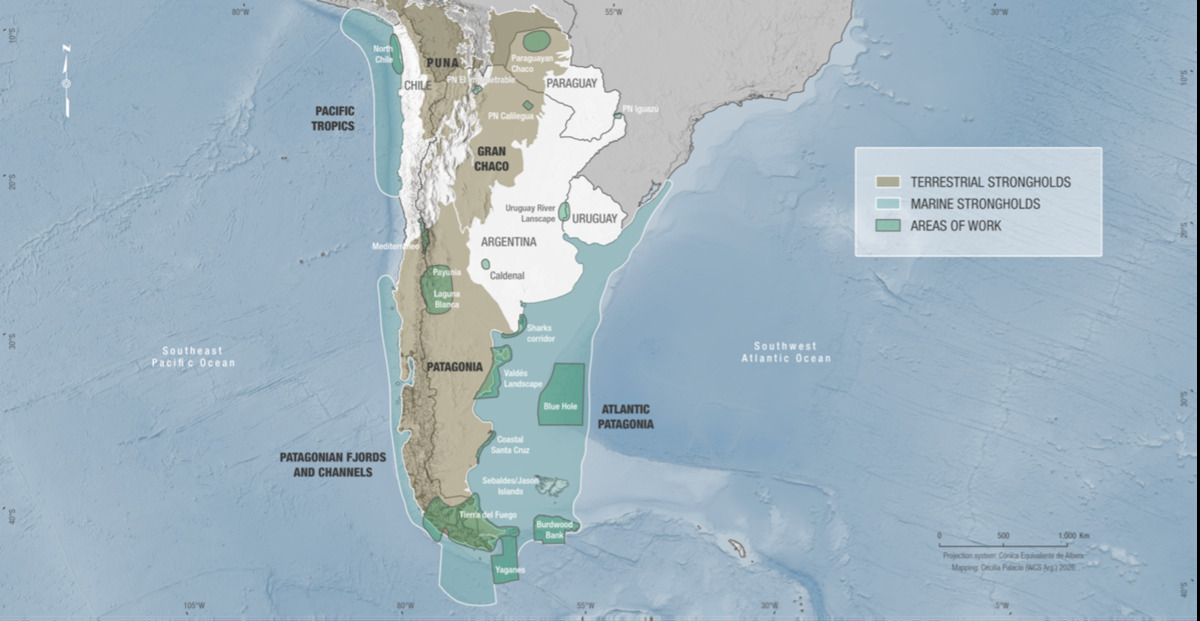
WCS is committed to the recovery and resiliency of the Southern Cone through the conservation and restoration of its most important strongholds for nature and people. These areas feature unique ecosystems, abundant and diverse wildlife, high ecological integrity, climate resilience and core cultural and economic ties for local communities. These habitats, wildlife, and local communities are at the core of our conservation efforts.
Drivers of Change
Terrestrial nature areas in the region face encroachment, fragmentation, and degradation from unsustainable agriculture, ranching and herding, as well as oil, gas, hydro-electric, mining, and infrastructure development increasingly driven by foreign investments. Wildlife is threatened by habitat loss and degradation, exotic species, hunting, and environmental crime.
Marine ecosystems are threatened by illegal, unreported, and unregulated (IUU) and unsustainable fishing, illegal kelp harvesting, prey depletion, by-catch, unregulated tourism, and pollution.
The effects of climate change across landscapes and seascapes are increasingly evident through desertification, glacier retreat, and shifts in the spatial and temporal distribution of terrestrial plant productivity, marine resources, and dependent wildlife populations. In addition, declared terrestrial and marine protected areas (PAs) in the region often lack adequate financial resources, governance mechanisms, trained staff, and monitoring tools to effectively implement conservation actions and achieve effective management.
The pillars of our work in the Southern Cone are the establishment, expansion, and effective implementation of climate-smart protected areas and corridors that enable wildlife conservation, local wellbeing and provide nature-based solutions to climate change. Since only some of the natural habitat and wildlife will ever be formally protected, globally, and most negative pressures to natural and human wellbeing originate outside PAs, we work to promote the co-existence of wildlife and people outside protected and conserved areas with a multifaceted toolkit. We work in close collaboration with Indigenous Peoples and local communities to promote a human rights-based approach to equitable conservation and natural resource management.
Across the region, we work to support and leverage local, national, and international policies related to biodiversity, sustainability and climate change mitigation and adaptation, and One Health. Additionally, we support various capacity building efforts across our sites, countries and region in collaboration with local authorities and academia.
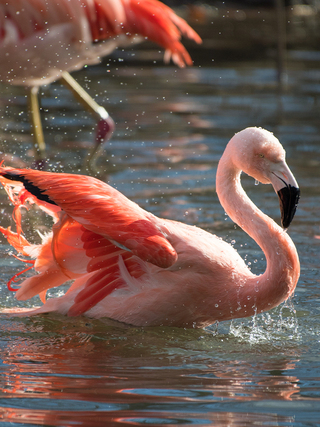
WCS works across some of the Southern Cone’s most important landscapes, from forests and grasslands in the Chaco to Patagonia’s steppe coasts and seas. These regions are home to unique ecosystems and support iconic wildlife such as jaguars, pumas, condors, flamingos, guanacos, whales, and penguins, while also providing critical ecosystem services like carbon storage and productive marine habitats. Across Argentina, Chile, and Paraguay, WCS focuses on conserving large connected ecosystems that sustain both biodiversity and climate resilience.
Our Teams
The Southern Cone region groups three established country programs and collaborative initiatives in a fourth country, with a regional team that supports them and links our on the ground operations with our organization at-large.
Our oldest program, WCS Argentina was established in 1964 and holds country offices in the capital of Argentina, Buenos Aires, in Andean and coastal Patagonia.
WCS Chile was established in 2005. The team works in southern and central Chile, with offices in the country’s capital, Santiago, and in the Patagonian city of Punta Arenas.
Our youngest country program, WCS Paraguay was established in 2010 and operates mostly in the Paraguayan Chaco. Its country office is in the capital city of Asunción.
Our collaborations in Uruguay leverage professionals from our country and regional teams and are focused on the establishment and strengthening of protected areas in the country.
The small regional team has its members distributed throughout the region and in New York.